The Opportunity for Cambodian Coconuts: Market Data, Export Strategy & Value-Add Potential
🔍 Executive Summary
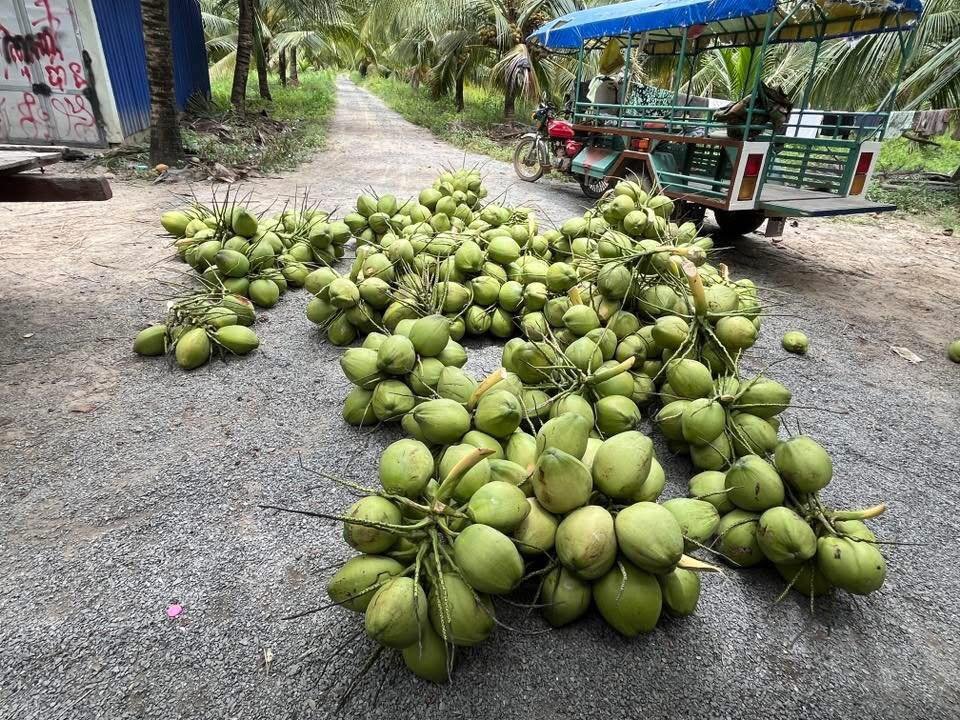
Cambodia’s coconut sector, long under-utilized, is showing promising signs of transformation. With nearly 258,935 tons annual production, favourable agro-climatic conditions, and new access to large export markets, there’s significant potential to scale up — not just in raw exports, but through value-added products, branding, and sustainable practices.
1. Current Landscape & Key Data
Here’s a snapshot of the industry’s state in Cambodia:
| Indicator / Metric | Value / Observation | Source / Notes |
|---|---|---|
| Annual coconut production | ~258,935 tons (recent year, +2.4 % YoY) | Tridge+2ACLEDA Securities+2 |
| Total plantation area | ~19,998 hectares (of which ~14,225 ha harvested, ~71 %) | Tridge+2ACLEDA Securities+2 |
| Major producing provinces | “Prairie Province” leading (~22.8 % contribution), followed by Kampot (~21.1 %) and Battambang (~9.5 %) | Tridge |
| Export of fresh/dried coconuts (2023) | Very minimal: ~190 kg for ~US $0.95 K | World Integrated Trade Solution |
| Export of coconut/copra/oil fractions | Exports of copra/fractions ~US $6.5 million (12,822 t shipped) in 2022 (mainly to Malaysia & Thailand) | World Integrated Trade Solution |
| Phytosanitary access / export protocol | Fresh coconuts approved for export to China via protocol signed in 2023; plantations and processing facilities registered for export | ACLEDA Securities+2Cambodianess+2 |
| Household involvement | Over 600,000 agricultural holdings reportedly grow coconut (in survey data context) | nis.gov.kh |
🔎 Interpretation
- Production base exists: With ~20,000 ha planted and a stable annual output, Cambodia already has the foundation for coconut agribusiness.
- Low export penetration currently: Despite production capacity, actual fresh/dried coconut exports are almost negligible, showing a gap/opportunity in supply chain, certification, or market linkage.
- Existing export credentials: Recent government/industry achievements (e.g. access to China market) open doors for export expansion.
- Smallholder dominance: Many growers are small-scale, which poses both a challenge (fragmentation) and an opportunity (inclusiveness, brandable “origin” produce).
2. Market Trends & Global Context
Understanding global coconut product demand and trends helps position Cambodia:
- Diverse product potential: Mature coconuts and their derivatives (water, meat, coconut oil, coir, peat, activated carbon, etc.) make coconut a versatile crop offering many value-added paths. Global Inst
- Growing health / wellness demand: International interest in natural products, functional foods, and tropical fruits supports demand for coconut-based items. Global Inst
- Export demand in Asia: With access to large imports like China (post-protocol), Cambodian producers may tap into high-demand markets for fresh or processed coconut products.
3. Strategic Export & Value-Add Pathways
Here are strategic pathways tailored for Cambodia’s coconut sector:
3.1 Export Strategy
- Target market differentiation: With fresh coconut export access to China, register plantations/packing units according to phytosanitary requirements and develop export-ready supply chains.
- Incremental export roll-out: Begin with pilot consignments and cooperatives that meet traceability and quality standards, then scale.
- Certification & compliance: Promote Good Agricultural Practices (GAP), hygiene, post-harvest handling to meet market demands and reduce rejections.
- Trade partnerships: Develop partnerships with importers abroad and engage in market intelligence to secure demand.
3.2 Value-Added & Branding Strategy
- Processing: Invest in processing for coconut water, oil, desiccated coconut, and specialty products rather than just raw export.
- Niche products & origin branding: Highlight unique varieties (e.g. regional/waxed or aromatic coconuts) to command premium pricing.
- Zero-waste downstream: Leverage all parts of coconut (husk, shell, fiber) for coir, biomass, or activated carbon sectors.
- SME engagement: Support smallholders to access value chains (packaging, cooperatives, marketplaces like Foodbodia.com).
- Sustainability appeal: Market organic or sustainably farmed coconut to niche buyers in ASEAN, Japan, EU, leveraging sustainable credentials.
4. SWOT Overview
| Strengths | Weaknesses |
|---|---|
| Favorable climate & established plantations | Fragmented smallholder farming structure |
| Government-supported export access (e.g. China) | Low current export volumes & limited processing infrastructure |
| Diverse uses (raw, water, oil, waste valorization) | Need for improved certification/traceability |
| Growth potential for value-add & branding | Competition from established coconut exporters globally |
| Opportunities | Threats/Risks |
|---|---|
| Rising global demand for coconut products | Price volatility & global competition |
| Export to premium markets & product niches | Infrastructure limitations (logistics, cold chain) |
| Processing/industry development & upgrading | Pest/disease risks & smallholder adaptability |
| Inclusion of rural populations and sustainable models | Regulatory/market entry barriers abroad |
6. Key Stakeholders & Strategic Actions
| Stakeholder | Role / Action |
|---|---|
| Farmers & Cooperatives | Adopt quality standards, collaborate for scale, engage in traceability systems |
| Export Companies / Processors | Invest in grading, cold chain, certification, and explore niche markets |
| Government / MAFF | Support export protocols, provide extension services, infrastructural support |
| Investors | Develop processing facilities, R&D for product diversification, branding ventures |
| Marketplace Platforms (like Foodbodia.com) | Bridge supply-demand, promote quality listings, provide export readiness education |
7. Roadmap for Implementation
- Baseline Survey & Capacity Assessment: Map active coconut plantations, processing units, and assess quality standards.
- Pilot Export Trials: Identify compliant farms/facilities for pilot exports under China export protocols.
- Product Diversification Development: Set up small-scale processing for value-added products; emphasize branding & packaging.
- Stakeholder Collaboration: Engage cooperatives, private sector, government, and financing partners to scale investment.
- Marketing & International Outreach: Attend trade fairs, build importer relationships, and promote Cambodian coconut as premium origin.
- Monitoring & Sustainability: Implement certification (GAP/organic), traceability, and by-product waste valorization for sustainability.
8. Conclusion
Cambodia’s coconut potential is real and timely. With established production, rising global demand for coconut-based products, and newly unlocked export access, the sector stands at a pivot point. Through strategic investment, value-addition, and effective stakeholder collaboration — Cambodia could transform its coconut industry into a strong export-led growth engine, benefitting farmers, businesses, and the national economy alike.
📚 References
- Tridge, “Cambodia’s annual coconut output is nearly 260,000 t” Tridge
- Cambodia’s export/cultivation & phytosanitary protocol data ACLEDA Securities+1
- Trade data on copra/oil exports World Integrated Trade Solution
- Household and survey-based plantation/holdings data nis.gov.kh
Leave a Reply